
Knitting and Designing with Two Yarns Held Together

Knitters are creative souls who love to bring our own style and fair to knitting. When knitters and designers blend their own yarns, we create a unique fiber! Sometimes you can’t find the perfect yarn for a design, or you may just like the look and feel of two yarns held together.
By holding two different colored yarns together while knitting, you can tone down a bright color (try combining a neon yarn with a dark neutral color like grey or brown.) You can also lighten a darker colored yarn by combining it with a pale, neutral color. When you use contrasting colors together, you get a busy, marled look.
If you use light and dark shades of the same color, or two exact colors of different fibers together, the focus leans more towards texture instead of color.
The same color in merino and mohair, will give an even colored, but fuzzy texture that has a cozy look and feel.
Before casting on, there are some considerations to think through:
Yarn Weight
Probably the most important, is that the yarn weight will change.
Most of the time, we’re working with two different weights of yarns. So instead of referring to a generic chart that tells what two yarns of the same weight equal when used together, treat your combination uniquely.
This is super simple to do and works with the specific yarns you’re using.
Hold both yarns together, as if they were one yarn, and wrap them around something with a uniform circumference such as a pencil or larger sized knitting needle.
Wrap the yarns for a few inches. Don’t worry about counting anything. Make sure the strands are lying next to each other without overlapping or any gaps in between. It should look neat. You should be able to see both strands. If you are using a very fine yarn that you want to bloom like mohair, do not squish the stitches so close together that they hide the mohair. Leave some air for it to fill with its lovely fuzzy nature.

With a ruler, measure how many wraps are per inch. Measure in a few different places just to be sure. The results will change if you pull the yarn tightly, or leave it loose and dangly, but if all is uniform, this is a good way to find out what your new “yarns-held-together” weight is.
Now that you know the number of wraps per inch you’re getting, refer to the below chart from Craft Yarn Council to convert this to a yarn weight.

You now know your yarn weight. This makes it easy for knitters to find a pattern and designers have a better idea of what size needles to start swatching with.
The Swatch
Work the gauge swatches with both yarns held together. Treat this new blend as one piece of yarn. The characteristics of each fiber affect the overall behavior of the newly formed yarn so spend extra time swatching with different needles until you’re happy with the look and feel of the fabric.
Calculating Yardage
If the yarns are held together throughout, the yardage for one yarn will be the same yardage for the other yarn, regardless of the yarn weight. In the below photo, 7” of lace weight mohair is the same as 7” of DK weight merino.

Estimating Yardage in Advance
Designers will need to estimate yardage in advance before the sample is knit. To do this, weigh each yarn separately before starting just to make sure that that the weight of the ball is the same as the ball band says. It’s common for a ball to weight a few grams more or less. Write down the weight of the heavier yarn for this exercise.

Knit a swatch with both yarns held double. Weigh what is left over from the same ball of heavier yarn. Subtract to find out how many grams of yarn you used in your swatch. Measure your swatch. In this example, I used the DK weight, Gloss.

My 24 square inch swatch uses 9 grams of Gloss. Next calculate how many square inches the sample size that you're making will be. You’ll get these measurements from your schematic or grading worksheet. For set-in sleeves and raglans, there is more to consider with cross back measurements and sleeve caps, but for this example, I’m using the simplest silhouette, the drop shoulder sweater: Overall length x circumference plus each sleeve (cuff circumference + upper arm circumference, then divide by 2 for the average circumference then multiply by sleeve length). Don’t forget to add in both sleeves. My sweater is 1025 square inches.
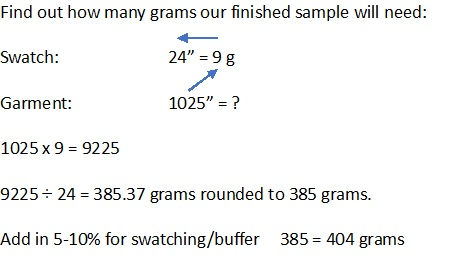
We are estimating that our sample will need 404 grams of Gloss DK weight yarn.
If 50 grams = 123 yards according to Gloss’ ball band, then 404 grams = 993.84 yards rounded to 995 yards.
Remember this is the yardage for only the Gloss DK weight yarn. If the yarns are held together throughout, then you’ll use the same yardage for the mohair as well.
This garment is estimated to use 995 yards of Gloss DK and 995 yards of Aloft mohair.
Reasons to NOT knit with yarns held together
Probably the most common reason is that your project will cost more since you’re working with two yarns instead of one. Even if you’re knitting on larger needles and getting more fabric with fewer stitches with yarns held together, you will still use more yarn than if you knit with only one yarn.
The second reason might be the stitch pattern. Are holding both yarns together too fiddly with your stitch pattern? Swatch and make sure you can work the stitches without too much difficulty. Are increases and decreases harder to work? Are cables becoming frustrating? Double decreases might need to be worked loosely if one of the yarns is inelastic, so does this affect the overall look?
The nature of using two yarns held together will remind you of knitting with a yarn that is splitty because the two yarns are not intertwined and it’s easy for your needle to split them apart. If you’re annoyed by splitty yarns, this technique probably isn’t for you.
Cables might work, depending on your fiber choices. So, let’s look at why fiber matters.
Choose your Yarn Wisely
Fiber
If both of your yarns are inelastic like cotton and linen, you’ll really want to think about which stitch patterns you want to use. Stockinette would be lovely. Cables would not. It will just be too difficult to form cables with two yarns held together that have no give.
Cables formed with two yarns held together will also be bulkier so think about how this will feel. If both of your yarns are wool-based and stretch easily, and the yarn held doubled is not too thick, then cables would be a good choice.
You can match the fiber qualities, like two stretchy merino yarns, or combine different ones, like merino and mohair. The qualities of each independent yarn will be diminished by the addition of the second yarn. If you hold a piece of merino and mohair together at both ends, and stretch them outwards, the elastic yarn will only stretch as far as the non-elastic yarn will let it. The inelastic yarn rules here so a merino is going to be less elastic held together with mohair than it will on its own.
Colors
Since you are holding two yarns together, you will always have a minimum of two balls of yarn to juggle at time. If you are using a hand dyed yarn without a dye lot, then you'll need to alternate balls of yarn every two rows to blend the shades which becomes tiresome and harder to manage. Now two balls have become four balls. Don’t make this more difficult that it needs to be.
Knitting with multiple colors in a row, whether it’s stranded knitting, or intarsia, becomes that much more difficult since you’re working with two balls of yarn for every color. It can be done, but it’s just something to think about.
When you want to add color to your piece, let the colors you selected of each yarn held together work their magic to bring color to your project.
Tips
When knitting, keep yarns even and don’t let the thinner yarn bunch up. This may require some yarn management practices as you knit by smoothing out each yarn as you pull more from the ball.
Carry yarns held together through entire piece, including cast on and bind off so that your stitches are uniform.
Working with two yarns held together may be the ultimate exercise in creativity for designers and is one where swatching becomes almost as fun as knitting the sample. Enjoy the process and keep an open mind about how the swatch, and your newly formed yarn is behaving.


Comments